COMMUNITY WIKI · OFFLINE SNAPSHOT
Rules v1.3.0
These are the abridged, current (v1.3.0) rules for the My Little Pony Card Game. These are abridged from the official rules, and may not be suitable for tournament play. See the official v1.3.0 rules PDF for complete rules. Rules text references are provided in superscript.
See Rules v2.0.0 for the upcoming beta rules made for sets SD02 and BP05.
Game Objectives
A player wins the game as soon as either of these conditions are met:
- They advance their Story to Stage IV.104.1.0 This is also stated on the Effect text of the Stage IV Story card.104.1.1
- Their opponent is required to, or attempts to, draw a card when their Main Deck is empty.104.2.0
Game setup
Deck preparation
Each player's seventy (70)-card Deck must consist of the following:102.0.0
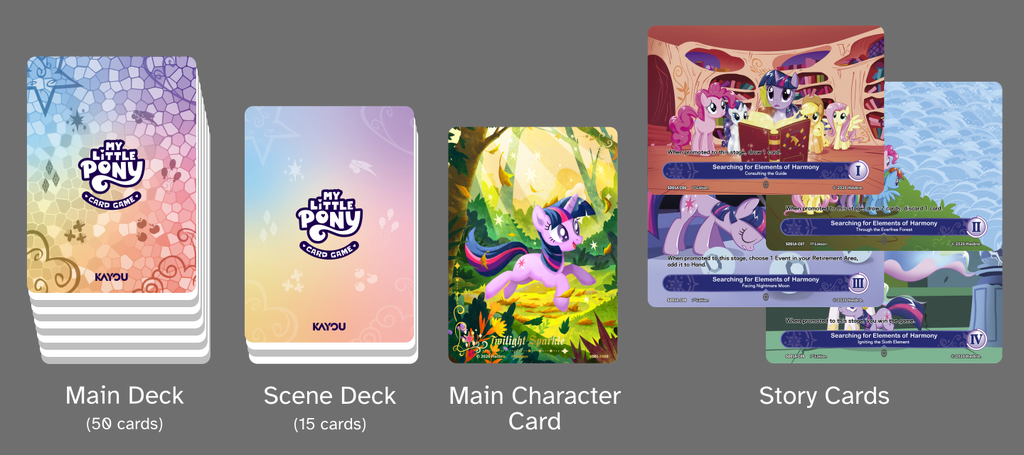
- A Main Deck consisting of fifty (50) Character, Event or Item cards;
- A Scene Deck consisting of fifteen (15) Scene cards;
- One (1) Main Character card;
- A set of four (4) Story cards sharing the same title, with different subtitles and numbered I, II, III, and IV.102.1.3
The Deck may only include up to four (4) copies of any card with the same card ID number.102.1.0 Cards marked with ※ are mechanically indistinct and share the same card ID as those without.102.1.1 For example, BP01-CR01 and ※BP01-CR01 are considered to have the same card ID. Cards with the "Everyday" mark are the exception; the Deck can have an unlimited quantity of these.102.1.2
Game area setup
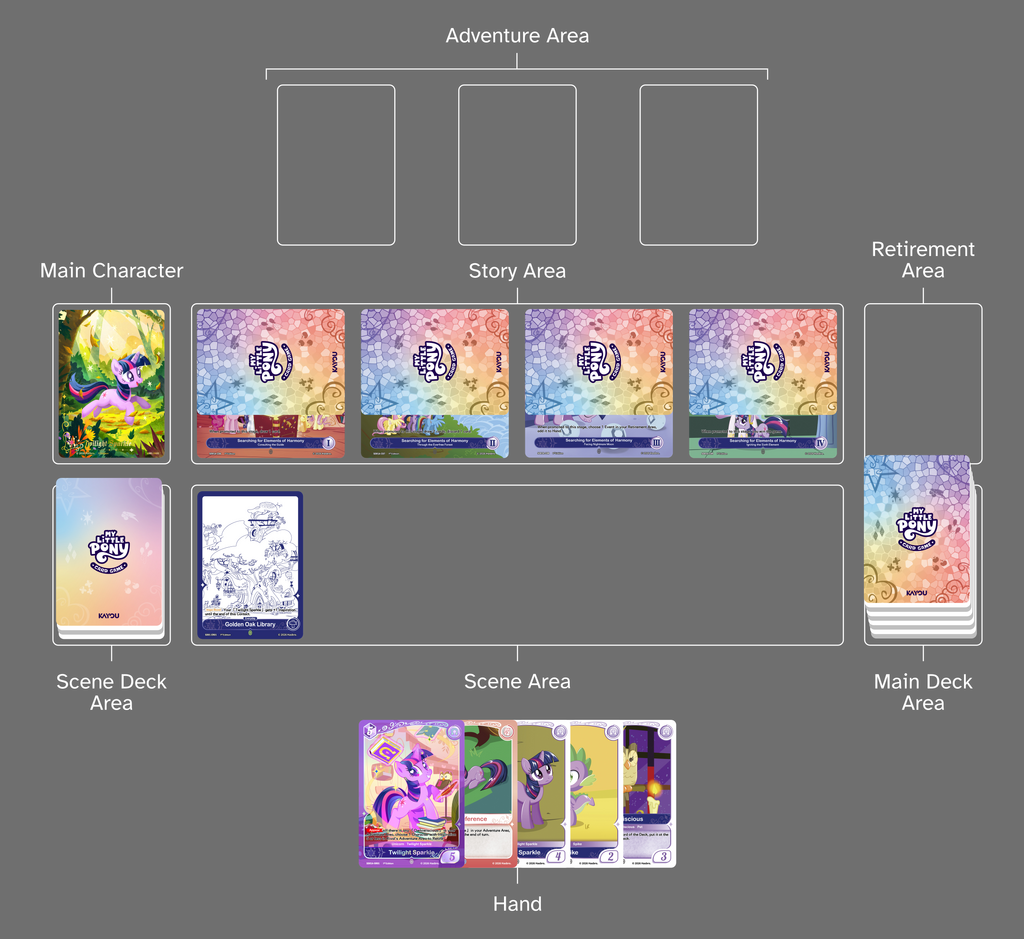
- Each player shuffles their Main Deck and Scene Deck separately, then places them face-down in their Main Deck Area and Scene Deck Area, respectively.103.1.0
- Each player places their Main Character card, then lays out the four (4) Story cards to its right in their Story Area in ascending order (I, II, III, IV).103.2.0
- Decide who goes first; that player becomes the First Player.103.3.0
- Each player draws the top five (5) cards of their Main Deck as their starting Hand.103.4.1
- A player dissatisfied with their starting Hand may take a mulligan. Mulligan means a player may move their entire Hand to the bottom of their Main Deck and draw five (5) new cards.103.4.1a-b Each player may mulligan only once per game.103.4.1c
- From the top of their Main Deck, each player draws the next four (4) cards and places them face-down, one (1) on each Story card. These are their Plan cards or Plans.103.4.2 Neither player may look at their own or Rival’s Plans during setup or at any time in the game unless instructed to do so by an Effect.
- Plans may be placed on top of the Story card with the Story's Effect exposed, or beneath the Story card with the Plan card exposed underneath.
- Finally, each player takes the top card of their Scene Deck and places it in their Scene Area, face-down if the player is going first or face-up if the player is going second.103.4.3
Abilities
Many Character cards (and some Item cards, when adorned by a Character) provide Abilities that change the dynamics of gameplay. Each Ability has a triggering condition, and an Effect which describes what actions must be taken on the game state when the triggering condition is met. Conditions for triggering card Abilities are noted by colored chips, with the given term inside, preceding the Effect text:
- Appear: Triggers when a Character enters the Adventure Area.201.6.1
- Farewell: Triggers when a Character leaves the Adventure Area.201.6.2
- : While a Character remains in the Adventure Area, this Ability is continuously active as long as the conditions of the Effect are met.201.6.4a-b, 501.1-2
- This may be followed by a Cost to activate the Ability, e.g. Tap, with "Tap" indicating that the Character card must be tapped (turned sideways) to use this Ability.201.6.4c, 501.3.0 See #Activate abilities.
- Pre-
plan: Triggers when a Plan with this Ability is revealed by Rival Intervening the Plan.201.6.3 - Inspo Boost: Short for "Inspiration Boost." Activate this Ability during the Inspiration Boost Step of a Contact by turning this Scene card face-down. This Effect may be used on any face-up Scene card, even if it is tapped.501.3.1 This Effect expires at the end of each lane of Contact.
- Explore: Activate this Ability during the Main Phase by turning this Scene card face-down. This Effect may be used on any face-up Scene card, even if it is tapped. It can only be activated if all parts of the Effect can be performed.501.3.2
Get +/- Inspiration, Cost of Force of Harmony
Effects can modify the Inspiration or Cost of Force of Harmony of a card, e.g. "gets +2 Inspiration" or "gets -1 Cost of Force of Harmony". This is added to or subtracted from the initial value shown on the card to form its total Inspiration or Cost of Force of Harmony.607.1-2 Any time a card's Effect checks for one of these values, use the current total with Effects, not the initial value.607.3.0 Characters cannot have a total Inspiration less than zero (0); if the sum would be negative, it becomes zero.607.1.0 Characters which reach zero Inspiration do not Retire.
Tap
Some Effects or Ability Costs may cause a card to become tapped, or turned horizontally. A card which is tapped may not be used again to pay a Tap Cost610.2.0 until it is untapped at the Start Phase or by a card's Effect.
Retire
When a Character Retires, it is moved from the Adventure Area to the Retirement Area.614.1 Usually, this occurs due to Contact,404.3.4b but some card Effects can also Retire Characters. If a Character being Retired has a Farewell Ability, it is triggered after leaving the Adventure Area, but before entering the Retirement Area.614.1.1-2
Cards by name
Some Effects may refer to a card by name with <Card Name>,201.1.0 e.g. BP02-SPR24 Party Cannon would be referenced as Party Cannon. Any card with the given name is a valid target for resolving the Effect. (Note: in this wiki, card reference chips link to the appropriate card page)
Play
The First Player begins Turn 1 and is now the Active Player. The First Player's opponent becomes the Rival player.
Start Phase
- Untap: The Active Player untaps all of their tapped (horizontal) cards by turning them vertically.402.1.0
- Draw: The Active Player draws one (1) card from the top of their Main Deck into Hand. On the first turn of the game, the First Player draws no card.402.2.0
- Add Scene: The Active Player draws one (1) card from the top of their Scene Deck and places it face-up into their Scene Area.402.3.0
Main Phase
During the Main Phase, the Active Player may perform any number of the following actions in any order:
Play a card from Hand
When a player plays a card, they must tap a number of Scene cards to generate Force of Harmony equal to that card’s total Cost of Force of Harmony (one can use face-down Scene cards as well as face-up ones).204.5.0, 403.0.0
- Character cards are played into any empty Slot in the Adventure Area.503.1.7, 503.2.1 If the Character has an Appear Ability, its Effect is triggered when it enters the Adventure Area.201.6.1
- Event cards have an Effect which resolves immediately on play;503.2.3 they then are moved to the Retirement Area.
- Item cards may be adorned (attached) to one of the Characters in the Adventure Area.503.2.2
- Some Items may have requirements about what Character it may be adorned to.503.1.8, 503.2.2
- Each Character can only be adorned with one Item at a time. If a player plays a new Item card to adorn a Character that already has an Item card, they must send the old Item to the Retirement Area.503.2.2
Activate abilities
When a player activates an <Cost> Ability of a Character in their Adventure Area, they must:
- Declare their intention to use the Ability.503.1.0
- Pay the listed Cost; examples:503.1.0
- Tap: the player must tap the Character card with the activated Ability.
- Tap, discard 1 card: the player must tap the Character and discard 1 card.
- Resolve the Effects of the Ability.
Contact Phase
Skip this Phase on the first two (2) turns of the game (both players take one turn each).404.1.0 Starting from the left-most lane relative to the First Player, Characters in both players’ Adventure Areas Contact each other one lane at a time.404.2.0 First Player resolves lanes from left-to-right, and Second Player from right-to-left. After all three lanes have resolved, this Phase ends.
When resolving each lane, one of three situations can occur:
Contact
If both players have a Character in this lane, the Characters Contact:404.3.0
- Active Player may choose whether to Inspiration Boost the Character with Inspo Boost Effects. If they choose to do so, they select any number of Scene cards, flip those cards face-down, and resolve each flipped card’s Inspo Boost Ability.404.3.1
- Rival may choose to Inspiration Boost in the same manner.404.3.2
- Note: Once Rival begins Inspiration Boosting Characters or elects not to Inspiration Boost, the Active Player may not further Inspiration Boost their Characters.
- Resolve the Contact by comparing the two Characters’ total Inspiration values:404.3.3-4
- The Character with the lower total Retires (moves to the Retirement Area).
- If both totals are equal, both Characters are Retired.
- If any Character being Retired has a Farewell Ability, it is triggered now.201.6.2 If both Active Player and Rival have Effects which would trigger at the same time, the Active Player's Effects resolve first.504.6.0
- Finally, all active Inspo Boost effects expire.
A Character being tapped or having moved from another lane does not affect whether the Character Contacts. Tapped Characters engage in Contact just as untapped Characters. Characters which move to a later lane in Contact Phase may Contact again, and Characters which move to an earlier lane may not Contact at all.
Take Action
If only the Active Player has a character in this lane, the player will Take Action404.4.0 and may choose to either:
- Promote the Story: Active Player advances (moves) their Main Character card forward to the next Story stage. If the Main Character is at its initial position (left of the Story Area), advance it to Story Stage I. This action may only be taken if Rival does not have a Plan on the same Story stage that the card would be advanced to; if Rival does have a Plan at that Story stage, the Active Player must Intervene the Plan instead.404.4.1
- If Rival later recovers a Plan due to a card Effect, player does not move the Story to a previous stage; it stays at its current position.
- Intervene the Plan: Rival must reveal the Plan on the lowest stage Story card in their Story Area that has a Plan on it. For example, if Rival has Plans on Stages I, II, III, and IV, they reveal the card on their Story's Stage I.404.4.2
- If the revealed card has a Pre-plan Ability, resolve its Effect, then move the card to the Retirement Area.201.6.3 (This is mandatory even if the Effect would result in no actions, or even if Rival would rather wish to move card to Hand in lieu of its Ability.)
- If not, the Rival adds that card to their Hand.
Skip
If the Active Player has no Character in this lane, they Skip the Contact and take no action.404.5.0 This applies regardless of whether Rival has a Character in that lane.
End Phase
At this point, all "until the end of turn" Effects end.405.1.0
There is a ten (10) card maximum Hand size at the end of a player's turn. If a player ends their turn with eleven (11) or more cards in Hand, they must discard cards to the Retirement Area until they have only ten (10). Players get to choose which cards they wish to discard, and only during the End Phase of their own turn, not Rival's turn.405.2.0 Cards discarded in this manner do not trigger Abilities.602.3.0
It then becomes Rival's turn: the Active Player becomes the Rival, and the previous Rival becomes the Active Player.
Repeat the above Phases in turn order until one player meets a Game Objective and wins the game.
This is the end of the essential rules of the game. Below sections provide more information about terminology and the layout of the cards and game area.
Game area
Main Deck
The Main Deck is a face-down stack of Character, Event and/or Item cards placed in the Main Deck Area.301.0.0 At the beginning of setup, there should be fifty (50) cards in the stack.102.0.0 Neither player can inspect the Main Deck unless instructed to do so by card Effect.301.0.0
Scene Deck
The Scene Deck is a face-down stack of Scene cards placed in the Scene Deck Area.302.0.0 At the beginning of setup, there should be fifteen (15) cards in the stack.102.0.0 Neither player can inspect the Scene Deck unless instructed to do so by card Effect.302.0.0
Scene Area
The Scene Area is where drawn Scenes are placed.305.0.0 Once game setup is completed, this area should have only one (1) Scene card, either face-down for First Player, or face-up for their opponent.103.4.3 This is an open area which can be freely inspected by either player, including face-down cards.305.1.0
Story Area
The Story Area consists of four (4) face-up Story cards laid left-to-right in sequential order, a single Main Character card, and up to four (4) Plan cards.304.0.0 Once game setup is completed, each Story card should have a face-down Plan card drawn from the Main Deck placed with it, and the Main Character card should be placed face-up to the left of the Story cards.103.2.0 Neither player may inspect Plan cards, nor rearrange Story or Plan cards, unless instructed to do so by card Effect.304.1-4
Adventure Area
The Adventure Area consists of three (3) Slots, each for placing a Character card303.0.0 as well as an adorned Item card. Each Slot, when paired with the Slot directly across from it in Rival's Adventure Area, forms a lane for engaging in Contact. Cards in this area are always face-up, and may be freely inspected by either player.303.0.0
Retirement Area
The Retirement Area consists of Main Deck cards which have been removed from play, e.g. from being discarded or Retired.306.0.0 Cards in this area are always face-up, and may be freely inspected be either player.306.1.0
Hand
The Hand consists of any number of drawn Main Deck cards,307.0.0 conventionally placed in the player's hands. Cards in this area may only be freely inspected and rearranged by that player.307.1.0, 307.4.0 A player may only know the number of cards in their Rival's Hand,307.2.0 not the contents. Once game setup is completed, there should be five (5) cards in Hand.103.4.1 At the end of the Discard Step of the player's End Phase, there should be no more than ten (10) cards in Hand.307.3.0
Card types
Common features
Elements common to all card types include:
- Card Type: An icon representing the type of card.
- Rarity: The rarity of the card. Does not affect gameplay.201.3.0 Represented by a gem symbol of various colors, see #Rarities.
- Card ID: An identifier to distinguish mechanically unique cards.201.8.0 Consists of three to four parts in the following sequence:
- Print information: Does not affect gameplay.201.9.0
Rarities
The following symbols and abbreviations are used to indicate the rarity of the card for collection purposes:
| Gem | Abbrev. | Rarity Name | Usage |
|---|---|---|---|
 |
C | Common | The most common Character cards, as well as all Story cards. |
 |
U | Uncommon | Character cards rarer than Common. |
 |
SR | Silver Rare | Character cards rarer than Uncommon. |
 |
GR | Gold Rare | Character cards rarer than Silver Rare. |
 |
CR | Colorful Rare | The rarest Character cards. |
 |
SPR | Sapphire Rare | Event and Item cards. |
 |
ER | Emerald Rare | Scene cards. |
 |
RR | Ruby Rare | Main Character cards. |
| PR | A promotional card. The actual rarity is indicated by the card's gem symbol. | ||
| TK | A Token card. Has no rarity. |
Character cards
Character cards form part of the Main Deck and are essential to play. They are used for resolving Contacts with Rival's Characters and have Abilities with Effects that can be activated during play.201.0.0
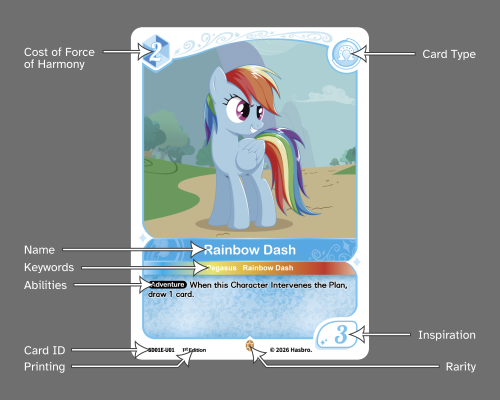
Character cards contain the following information as well as that common to all cards:
- Name: A name for the Character used for referring to the card in play.201.1.0
- Keywords: Describes features of the Character, including its name, what kind of creature it is, etc.201.4.0
- Cost of Force of Harmony: Located at the top-left, is the amount of Force of Harmony required to play the card.201.5.0
- Inspiration: Located at the bottom-right, is the amount of Inspiration that the Character starts with before any Effects are applied.201.7.0
- Ability: The trigger conditions and Effects of the Character's Ability. Not all Characters have an Ability.201.6.0
Event cards
Event cards form part of the Main Deck and provide instantly playable Abilities to supplement Character cards.
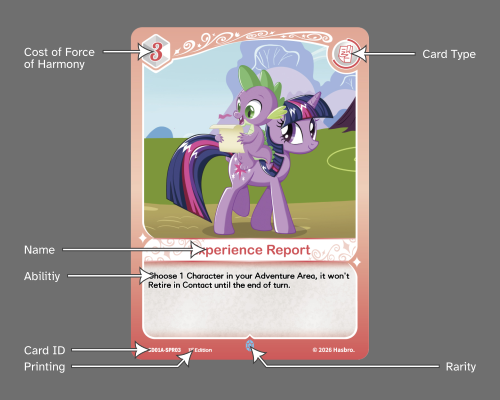
Event cards have Abilities which are activated by playing from Hand.202.0.0 Once an Event's Effects are resolved, it is moved to the Retirement Area.
Event cards contain the following information as well as that common to all cards:
- Name: A name for the Event used for referring to the card in play.202.1.0
- Cost of Force of Harmony: Located at the top-left, is the amount of Force of Harmony required to play the card.202.4.0
- Ability: The play requirements and Effects of the Event.202.5.0
Item cards
Event and Item cards form part of the Main Deck and give additional Abilities to Character cards they are adorned (attached) to.
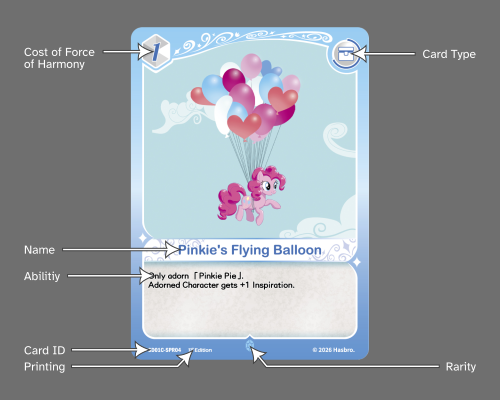
Event cards have Effects which are activated by playing from Hand.202.0.0
When a Character is adorned with an Item, it is placed in the same Slot in the Adventure Area as the Character card so that the Ability text of both cards are visible. A Character can only be adorned with one (1) Item at a time; if an Item is already adorned by the Character, the currently adorned Item must be sent to the Retirement Area and then replaced by the new one.203.0.0
Item cards contain the following information as well as that common to all cards:
- Name: A name for the Item used for referring to the card in play.203.1.0
- Cost of Force of Harmony: Located at the top-left, is the amount of Force of Harmony required to play the card.203.4.0
- Ability: The play requirements and Effects of the Item.203.5.0
Scene cards
Scene cards are the sole constituents of the Scene Deck. Each of these produce one (1) Force of Harmony when tapped, and provide Inspo Boost or other Effects when flipped.204.0.0
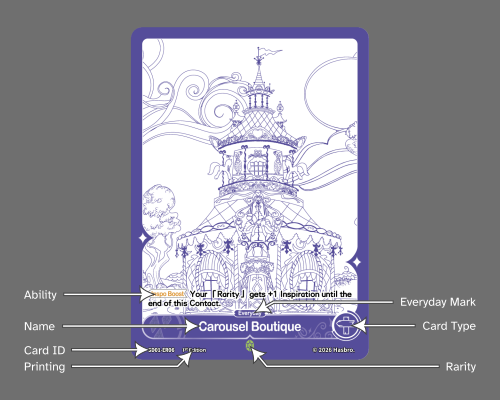
Scene cards contain the following information as well as that common to all cards:
- Name: A name for the Scene used for referring to the card in play.204.1.0
- Everyday: A mark which indicates that an unlimited quantity of these cards may be used in a Deck.204.4.0
- Ability: The Scene's Ability which is activated by turning the card face-down.204.5.0-2
Story cards
Story cards form the sequential stages of the Story Area through which players advance their Main Character.
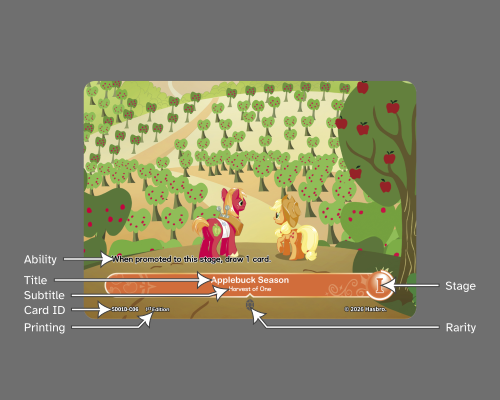
Story cards contain the following information as well as that common to all cards:
- Title: The name of the Story card. All cards in the Story Area must share the same title.206.1.0
- Subtitle: The name of the particular stage of the Story. All cards in the Story Area must have different subtitles.206.1.0
- Stage: The sequence number within Story, numbered I, II, III or IV. All cards in the Story Area must be one each of these stages in sequence.206.3.0
- Ability: The conditions and Effects of the Story card which are triggered when the player advances to this Stage of the Story.206.4.0
- Story Text: Text on the back of the card describing this stage of the Story. Does not affect gameplay.
Main Character cards
Main Character cards are used to mark at which stage in the Story the player has achieved. If players agree, any other object may be used in place of a Main Character.102.2.0, 205.0.0
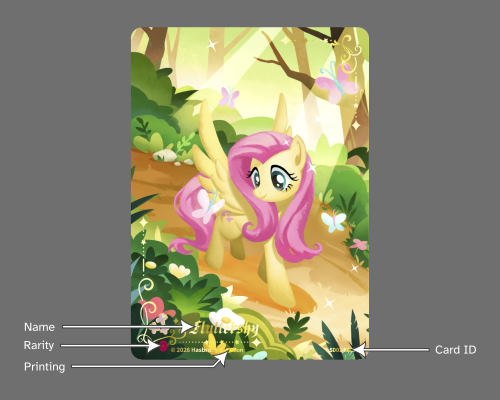
Main Character cards contain the following information as well as that common to all cards:
- Name: The name of the Main Character.205.1.0
Tokens
Tokens are cards or other objects used to indicate various conditions and Effects. They are not part of the Deck; they are placed outside of the game area and used when needed.207.1.0 Official Token cards have card ID numbers beginning with "TK-".207.1.1 In lieu of these, players may agree upon any other object to be used in place of a Token card.207.1.2
Currently, only Treat and Present tokens are in use.
Treat Tokens
Treat Tokens or Treats, used in the BP03 "Nightmare Night" set as TK-01 Treat, can be placed on Characters in the Adventure Area allowing them to be utilized by or to trigger card Effects.207.2.0 If a Character with a Treat leaves the Adventure Area, the Treat is Removed.207.2.1b Characters can only have one (1) Treat at a time. If a Character already has a Treat, Effects which would be triggered by giving that Treat do not trigger.207.2.1a
Present Tokens
Present Tokens or Presents, used in the BP04 "Hearth's Warming" set, can be placed on Characters in the Adventure Area,207.2.2a and have Abilities which trigger when unwrapped.207.2.2c If a Character with a Present leaves the Adventure Area, the Present is Removed.207.2.2e A Present may be unwrapped either during the Start Phase of each turn,207.2.2d or when a card Effect instructs it to be unwrapped.207.2.2c
There are six (6) types of Presents, one for each Mane Six character:207.2.2b-c
- Twilight Sparkle's Present
- Fluttershy's Present
- Pinkie Pie's Present
- Applejack's Present
- Rainbow Dash's Present
- Rarity's Present
Terminology clarifications
- "when"
- If the trigger condition occurs multiple times simultaneously, it only triggers the Ability once.501.1.3 Compare to "whenever."
- "whenever"
- If the trigger condition occurs multiple times simultaneously, it triggers the Ability that many times.501.1.3 (referred to as "Each time when") Compare to "when."
- "Remove"
- If the target is a Plan card, it is treated as if the player Intervened the Plan: its Pre-plan Ability triggers (if it has one) and is then sent to the Retirement Area.605.0.0 If the target is a Token, it is moved outside of the game area and no longer affects gameplay.605.3.0
- "until the end of turn"
- The Effect lasts until the Active Player's End Phase.
- "reveal"
- The card is shown and visible to both players until the current Effect resolves.611.0.0
- "Look at"
- The card is shown and visible only to the indicated player until the current Effect resolves, after which it is returned to its original location (unless stated otherwise). This Effect ignores normal area rules.613.0.0